
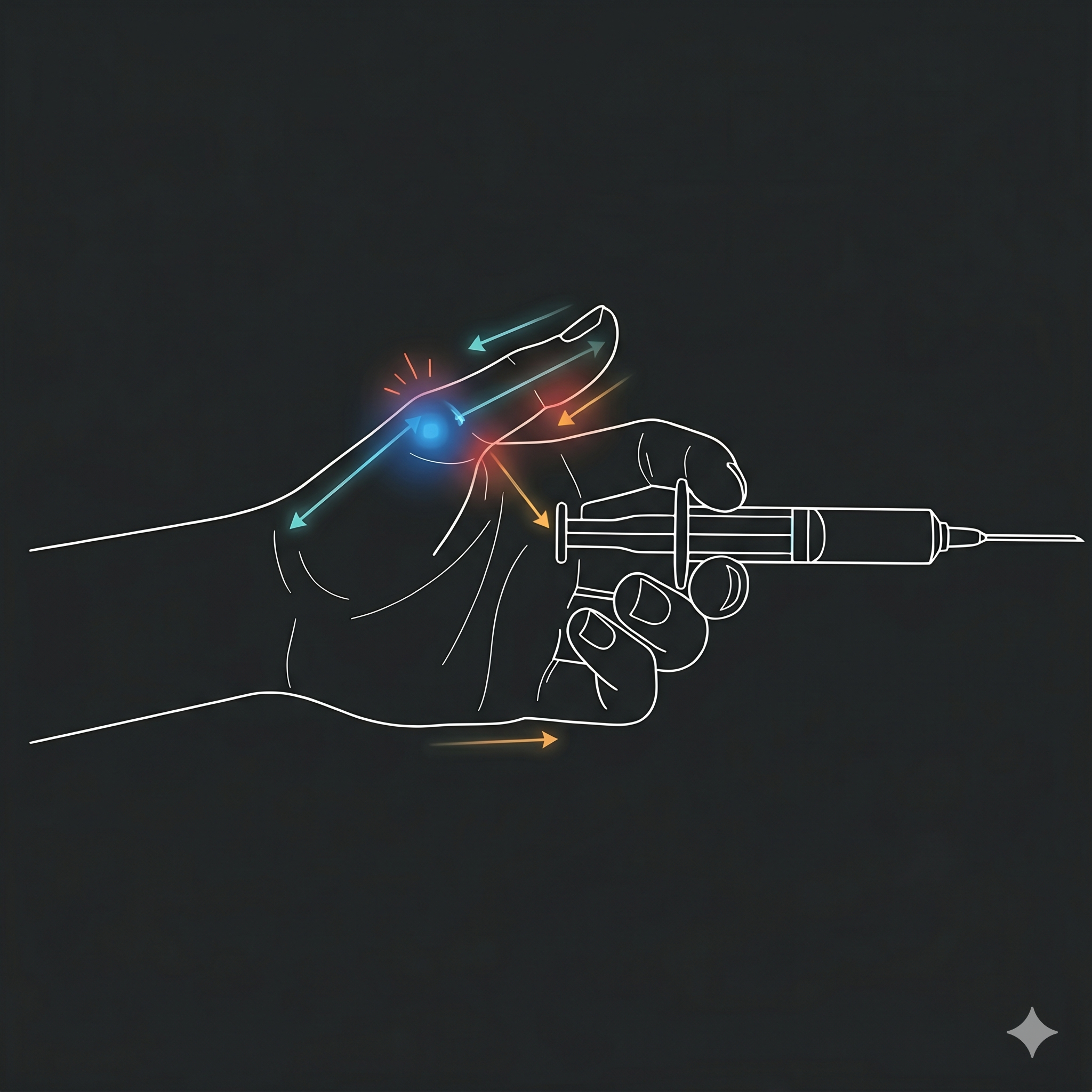
Take a look at our Control Ring. It’s a "syringe aspirator device".

It’s a "syringe aspirator device" engineered with an integrated, exact-fit adapter for your preferred filler syringe and a custom-sized, jewelry-grade thumb loop to promote controlled, consistent, one-handed aspiration.
But don't let that description fool you. 'One-handed aspiration' sounds simple enough, but it completely undersells what these tools actually need to achieve. Without an agreed-upon title or a standardized definition, the market has fractured into a wide range of design variability—proving that as an industry, we haven't even agreed on the core problem we’re trying to solve
That’s a massive mouthful, though, so we just lump ourselves in with "syringe aspirator devices" for short.
Yet, even that label fools people. "One-handed aspiration" sounds simple, but it masks a complex challenge...
Why is There No Clear Category Name for Syringe Aspirator Devices?
There is no clear category name for "syringe aspirator devices" beyond hip-firing working titles because manufacturers focus on branding individual tools rather than establishing a shared industry terminology for the specific physical job the tool performs—a clinical job that, once again, has never been properly defined.
Consider dermal filler. Whether you are using hyaluronic acid, calcium hydroxylapatite, or poly-L-lactic acid, the product category is completely clear. These gels have different crosslinking, different G-prime metrics, different particle sizes, and different indications. There is plenty of variety, but there is no question about what dermal filler is. The category is defined, and the variety lives inside that definition.
Syringe aspirator devices do not have that luxury. When medical providers search for them online, they can't rely on industry standards. Instead, they have to reach for whatever random working title comes to mind:
- Syringe aspirator device
- Aspiration ring for filler
- Syringe ring for one-handed aspiration
- Thumb loop adapter for dermal filler
None of those terms capture the actual category. The products in this space all have their proprietary brand names, but underneath those corporate labels, the industry lacks a shared language.
When a product category lacks a shared name, it usually lacks a shared definition too. Everyone built a standalone tool to fix a symptom, but nobody quite stopped to define the fundamental engineering problem underneath it.
That was the exact question we got stuck on before we designed the Control Ring. What does a device like this actually need to do? Or perhaps more importantly, what should it not do?
Are Dermal Filler Syringes Standardized Across Medical Brands?
Dermal filler syringes are not standardized across different brands, meaning each manufacturer designs unique syringe platforms, thumb depressors, and finger flanges for their specific packaging.
To understand the design challenge, look at the physical syringe and your thumb. At face value, those are the two obvious variables. The syringe is in your hand, your thumb operates the plunger, and the aspirator device lives in the space between them.
But your thumb is not separate from your hand, and your hand is not separate from you. The thumb is just the point of contact where the integration happens. Behind it sits your grip, your wrist, your forearm, your training, and your attention. The device must integrate with an unstandardized syringe on one side, and a human being on the other.
Let's look at the mechanical side. Think of the major dermal filler brands, including Juvederm, Teoxane, Restylane, Revanesse, and Radiesse. Outside the United States, the variety of shapes and sizes grows even wider.
In a perfect world, one size would fit all. We actually started there because Alyssa, my partner in life and business, wanted a single tool that worked across all the brands she used in her medical aesthetics clinic.
I started designing, and that is where the math fell apart. Every time I dialed in the fit for one syringe, another one drifted out of spec. Tightening the grip for the Juvederm caused the Radiesse to slip. Adjusting for the Radiesse made the Revanesse feel loose.
It was like trying to tune a guitar where every string you tightened pulled another one flat. There is no universal geometry to design against, only a moving target of different dimensions and profiles.
Why Does an Exact-Fit Syringe Aspirator for Dermal Filler Perform Better Than a Universal Design?
An exact-fit syringe aspirator outperforms universal designs by providing a zero-compromise mechanical attachment optimized exclusively for a single syringe platform.
When a design target is constantly moving, even an expert marksman is going to struggle to hit the bullseye every time. I stood there with no clear definition of the syringe we were designing against, and no obvious way to deliver on a promise to the love of my life.
That setback brought me right back to the original question. What should this device not do?
It should never force a medical professional to compromise. It should never ask an injector to settle for a "good enough" fit when they are working millimeters away from a critical facial artery.
I spent nearly a decade as an ICU nurse, so I am comfortable with chaos, as long as it is controlled chaos. These manufacturing variables were breaking the universal design process, so we made them static.
Alyssa did not need a tool to accommodate every syringe ever made across the globe. She regularly used four. I had already designed four individual adapters, each one optimized for a specific syringe brand. I realized I should stop trying to force one ring to fit four different shapes. I just needed to make four distinct rings that perfectly fit four specific syringes.
Exact-fit. One ring, one syringe, and no compromise. The chaos did not need a universal workaround. It needed an entirely new category of design that stopped looking only at the plastic packaging, and started looking at the person holding it.
How Do Hand Biomechanics and Anatomy Affect Dermal Filler Injections?

Hand biomechanics dictate that pulling a syringe plunger backward with a single thumb increases cognitive load and causes muscle friction, which actively degrades injection precision.
Fixing the syringe attachment was a mechanical problem, but fixing the human connection requires looking at how our bodies are actually built. Look at your thumb, and consider what happens to it when you try to pull back on a standard syringe plunger with only one hand.
Go ahead and try it. Mimic the motion right now.
Your index and middle fingers anchor the syringe flange, while your thumb has to reach up, hook over the top, and pull backward. It feels awkward because it is an inversion of natural hand mechanics. Evolution designed human hands to grip, to squeeze, and to push. Clenching a fist is powerful and intuitive. Spreading your fingers wide and pulling your thumb away from your palm under tension creates severe biomechanical friction.
In psychology and neuroscience, we call this cognitive load, which is the total amount of mental effort being used in your working memory. When an injector is struggling against the awkward physics of a standard syringe plunger, their brain is forced to do background math it should not have to do:
- Am I applying too much lateral pressure?
- Is the needle tip migrating half a millimeter while I pull back?
- Did I just lose my depth and plane of injection?
Every ounce of cognitive energy spent managing the basic mechanics of the hand is an ounce of cognitive energy stolen from the artistry of the face. When you are injecting into tissue spaces measured in microns, distraction is a major clinical liability. It is a vascular occlusion waiting to happen.
What is an Ergonomic Interface for Dermal Filler Syringes?
An ergonomic interface for dermal filler syringes is a specialized category of medical device that bridges the gap between human anatomy and unstandardized mechanical plungers to maximize clinical focus.
An aspirator tool is more than an optional assistive device, and it does more than just perform a mechanical aspiration. It functions as an ergonomic interface.
Think of it like the steering wheel on a performance car, or the hilt on a surgeon's scalpel. It is the vital bridge between intent and execution. By creating an exact-fit ring for each specific syringe, the tool itself functionally disappears and becomes an extension of the injector’s own anatomy.
When Alyssa puts the Control Ring on her syringe today, she does not feel the plastic or think about the adapter. She just feels the tissue and focuses entirely on the patient.
We started out trying to build a better tool, but what we actually ended up building was focus.
And as always, thanks for reading.
Ready to minimize friction from your injections?
Explore the Control Ring Exact-Fit Lineup and find the match for your clinic's syringes.

Share:
Reusable vs Disposable? Maybe That’s the Wrong Question.